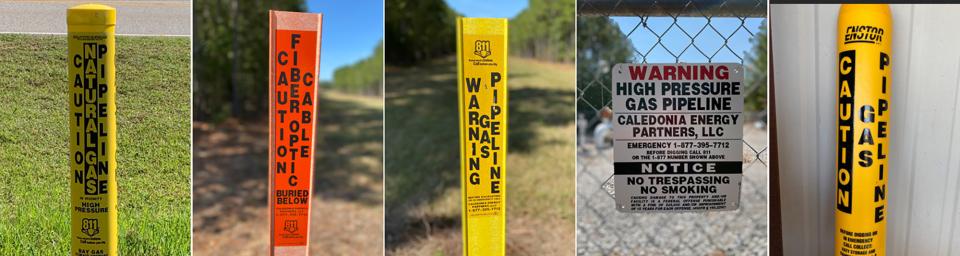
Look for the signs like those pictured here.
Since pipelines are buried underground, line markers like those pictured here are used to indicate their approximate location. These markers display the name of the pipeline operator and a telephone number where someone can be reached in case of emergency.
Pipeline markers are important to public safety. It is a federal crime for anyone to willfully deface, damage, remove or destroy any pipeline marker required by federal law. Markers indicate the general location of a pipeline. Keep in mind that the pipeline may not follow a straight course between markers. And they don’t indicate the depth or number of pipelines in the vicinity. To find out if a transmission pipeline is on or near your property you can go to the National Pipeline Mapping System Public Map Viewer at www.npms.phmsa.dot.gov.
Pipelines may be located anywhere – under streets, sidewalks or even in your own yard. That’s why it’s important to know where they are buried before digging for any reason. Whether it’s for planting trees, installing fences, grading for development or tilling farmland.
To ensure your safety and help prevent costly damage, call 811 to reach your local state One Call Center at least two business days before you start digging. The One Call Center will coordinate with all underground local utilities to mark the location of buried lines. This service is free of charge. Once all lines are marked, carefully use only hand tools to dig within 24 inches of marked lines. To review your local requirements, click on the applicable link below:
Digging and demolition near buried pipelines are the leading causes of pipeline damage, which can result in costly repairs, serious injury to bystanders, disruptions in gas service and delays in excavation-related projects. No damage is too small to report. Even a slight gouge, scrape or dent to a pipeline may cause a dangerous break or leak immediately or in the future.
If you cause what seems to be only minor damage to a pipeline, or any component attached to a pipeline, it is important to immediately notify the appropriate company by calling the phone number displayed on the pipeline marker(s).
Facility / Pipeline | Emergency Phone # |
|---|---|
| Alabama Intrastate Pipeline | (844) 940-3077 |
| AlaTenn Gas Transmission | |
| Bamagas Intrastate Pipeline | |
| MidLa Gas Transmission | |
| Mississippi Intrastate Pipeline | |
| MLGT North Intrastate Pipeline | |
| MLGT South Intrastate Pipeline | |
| Ozark Gas Transmission | |
| TransUnion Gas Transmission | |
| Bay Gas Pipeline and Storage | (888) 307-7595 |
| Mississippi Hub and Gas Storage | |
| Caledonia Gas Storage | (877) 395-7712 |
| Freebird Gas Storage | |
| Grama Ridge Hub and Gas Storage | |
| Katy Hub and Gas Storage |
Please note that calling one Enstor-affiliated company will not provide notification to other companies who might have lines in the area. Treat each affiliate as a separate company. And remember, one call to 811 will alert all area companies of your plans to dig.
Pipeline leaks are rare but may occur due to natural disasters, striking a pipeline while digging or corrosion. LOOK for dirt being blown into the air, water bubbling in a pond or river, or dead vegetation near a pipeline right-of-way. LISTEN for a hissing, whistling or roaring sound near a pipeline.
- Turn off and abandon any nearby motorized equipment.
- Quickly leave the area.
- Warn others to stay away.
- From a safe place, call the pipeline operator and your local fire or police department.
- Do not use open flames or anything that may spark ignition of the gas leak (telephones, flashlights, motor vehicles, etc.).
- Do not attempt to operate the pipeline valves.